

Sponsorships are a major investment for brands seeking to reach consumers around the hype of global sporting events. In fact, some of the world’s biggest brands invested a combined $2.8 billion for global access, exclusivity, and marketing rights for this year’s FIFA World Cup. These partnerships present a challenge and opportunity for marketing teams: how can they ensure their campaigns will drive the outcomes they want, before they spend billions to produce and distribute their ads?
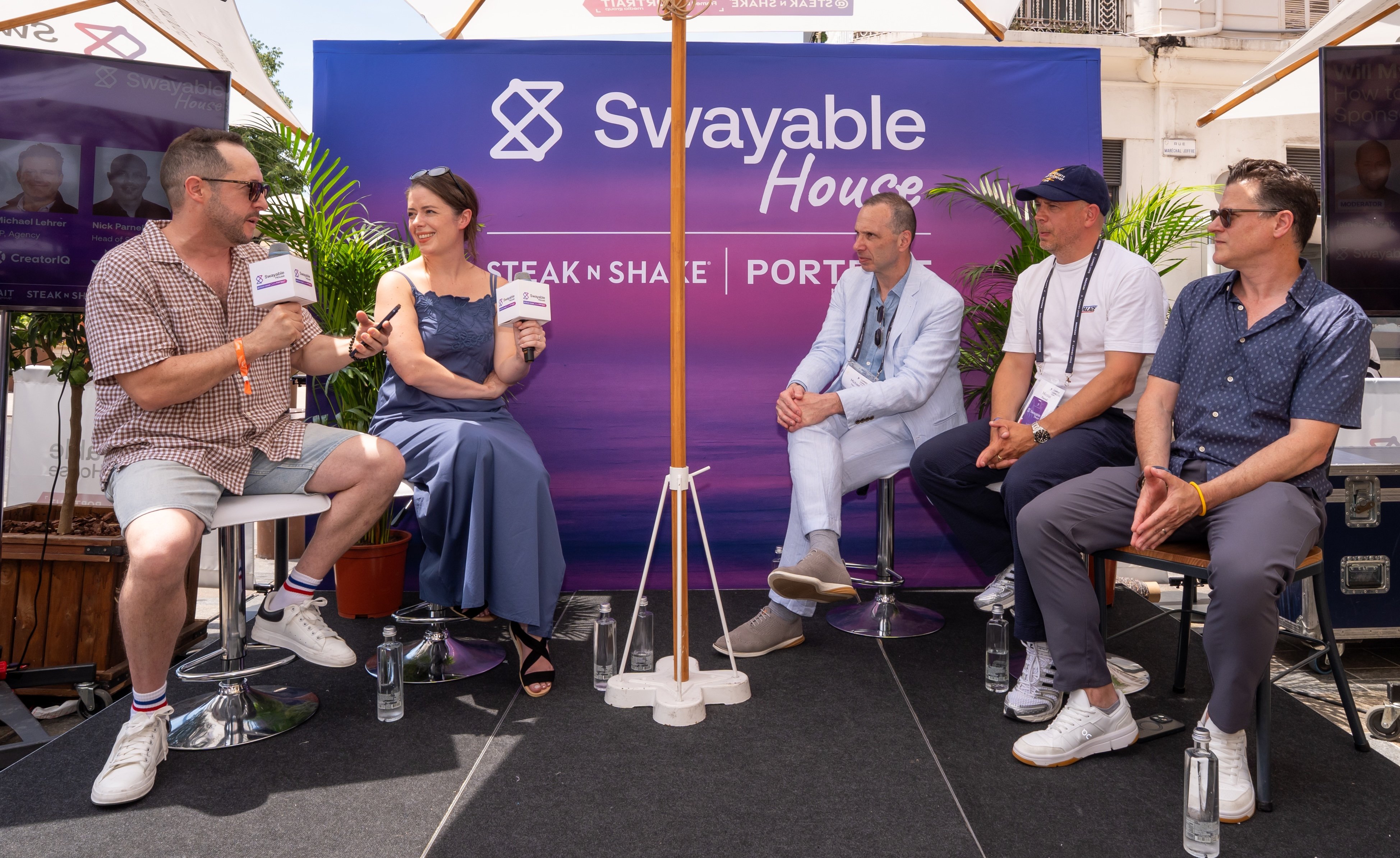 From left: Swayable's James Slezak, Omnicom Production's AJ, Visa's Michael Nevski, Edelman's Nick Parnell, and CreatorIQ's Michael Lehrer discuss brand sponsorship strategy at the Swayable House at Cannes Lions.
At the Swayable House at the 2026 Cannes Lions International Festival of Creativity, Angharad Jones (AJ), Global Chief Strategy Officer, at Omnicom Production ; Michael Nevski , Director of Global Insights at Visa; Nick Parnell, Head of Sport at Edelman; and Michael Lehrer, VP of Agency at CreatorIQ, joined Swayable CEO James Slezak to explore how marketing teams are building winning sponsorships for global events, and using pre-testing and AI-powered insights to validate strategy before going live.
Keep scrolling to to uncover key insights from their conversation.
1. Winning brands lead with genuine stories—validated by creative testing
With just under $3 billion being spent on FIFA sponsorships alone, the stakes for brands are high and the margin for error is slim. It’s an increasingly crowded space, and simply placing a logo on a jersey is no longer enough. The brands that stand out are the ones whose partnerships genuinely improve the experience for fans, players, and communities with intentional storytelling.
“Can we tell a genuine story that makes the fan experience, the player experience, the team experience, the show experience better?,” said Parnell at Edelman. “That’s where we involve testing upfront with consumers to really understand—is that collaboration between a brand and a sponsorship asset really going to work?”
Edelman's Nick Parnell on the importance of genuine storytelling for sponsorship success.
AJ at Omnicom Production also explained that for brands to activate successfully around mass monocultural events, they must be intentional about what they’re trying to achieve—from the audience they’re trying to reach to how they’ll measure and prove their sponsorship was a success.
“The brilliant thing about sponsorship—and the difficult thing about sponsorship—is that you get one go at it. The event happens, the moment happens,” said AJ. “That's why pre-testing is so exciting. You have this one chance to create all of these different experiences—but you have to be assured they're going to work."
Omnicom Production's AJ on how pre-testing is vital to validate consumer impact.
2. Rapid measurability is the new mandate
Impressions and engagement are no longer the “end all, be all” proof points for success. Stakeholders want to know whether sponsorship spend is actually moving the needle for lift across metrics including brand favorability and purchase consideration. Brands leading the way are building the data infrastructure to provide those proof points as quickly as possible.
Nevski at Visa described where measurement is headed. His team is connecting advertising exposure directly to consumers’ transactional behavior—making the link between creative investment and real business outcomes clearer than ever. "If I run a FIFA campaign, I will be able to see if any category spend is affected by that campaign directly in my combined database,” he said.
As AI becomes more central to how brands plan and measure sponsorships—from rapid creative prototyping to accelerating insights generation—Nevski also reiterated that human creativity is essential for sponsorship campaigns to succeed.
Visa's Michael Nevski on the significance of human creativity in building winning sponsorships.
"Sponsorships will continue to have a place because of human connections and interactions,” he said. “Technology and bots are still not going to replace that. They are trained on our answers, but they don't have that soul."
3. Creators aren't just amplifiers—they're proof points.
A major shift in sponsorship strategy over the past decade has been brought on by the rise of creators—not just as a distribution channel, but as a core part of how brands build, validate, and measure campaigns.
Michael Lehrer of CreatorIQ—a platform that works with brands to find the ideal influencers and measure their campaign effectiveness—explained that brands are leveraging creators not just to amplify sponsorships, but as content producers to create authentic stories surrounding major events. The ability to test creator selection and run rapid, AI-powered analyses on social performance is key to proving their success.
“The future of sponsorships is really about getting predictive insights into your audience,” said Lehrer. “The creator space is great for predictive insights, because you can run analyses on content and comments to measure favorability and sentiment.
The brands that will win the next cycle of major global sponsorships won't just be the ones that have the largest budgets. They'll be the ones that show up with intention, pre-test their assumptions early, and measure the consumer impact that actually matters.
Watch our Cannes session, "Will My Creative Work? How to Make Every Sponsorship Dollar Count," in its entirety below.