

Capturing the Latino swing state vote will be vital to turn the tides of the 2026 midterms and future U.S. elections. However, to successfully mobilize Latinos, advocacy organizations must create campaigns that deeply resonate with the community and reflect its cultural nuances. It’s why pre-testing messages in English and Spanish is vital to understand what actually works.
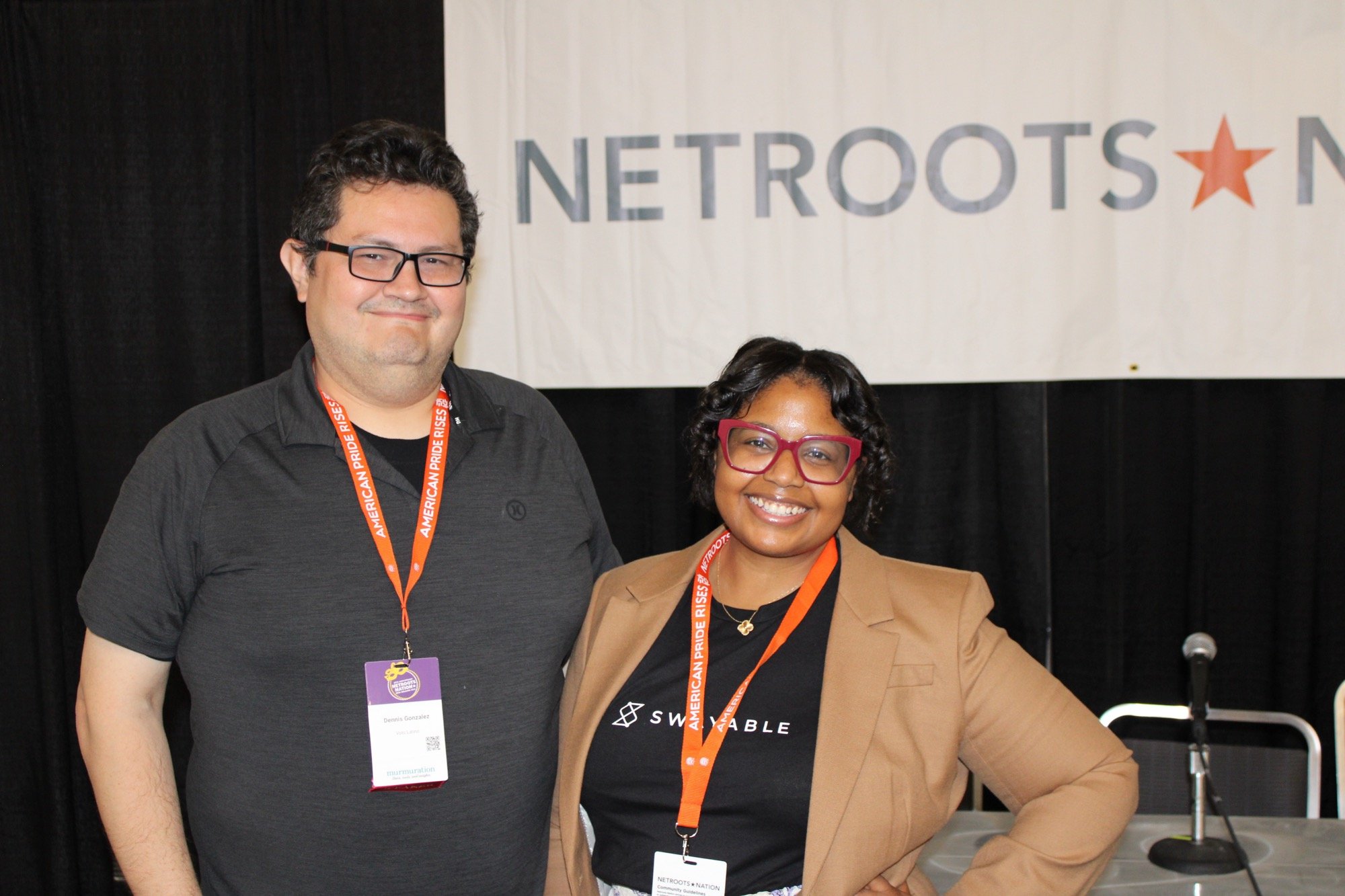
Voto Latino's Dennis Gonzalez and Swayable's Taylar Pompey Harrington shared key lessons from a message testing initiative at Netroots Nation 2025 in New Orleans.
Voto Latino, a nonprofit that encourages Latino people to register to vote and become more politically involved, understands the impact of message pre-testing firsthand: ahead of the 2024 U.S. presidential election, the organization used Swayable to conduct rapid randomized controlled trials (RCTs) to identify the types of messages, in English and Spanish, that were most effective in persuading or dissuading Latinos to vote for particular candidates.
Dennis Gonzalez, Chief Strategy Officer at Voto Latino, and Taylar Pompey Harrington, Senior Client Success Manager at Swayable, recently shared key findings and takeaways from this message testing initiative at Netroots Nation 2025 in New Orleans. Their training session explored how data-driven testing fuels campaign strategy, the types of messages that have and have not worked to engage Latinos, and actionable insights to refine voter outreach efforts.
“We’re all here because we believe the arc of justice bends when minds change,” said Harrington. “What we’ve learned from the last election cycle is that facilitating that process for important voting blocs is going to be key to our future.”
Advocacy groups are keeping these takeaways in mind to build more successful mobilization campaigns:
1. Capturing language and cultural nuance is vital. Messaging that resonates in English doesn’t necessarily resonate in Spanish, and vice versa. Even within Spanish-speaking communities, regional differences—like the nuances among Tejanos, Puerto Ricans, and Venezuelans—require tailored approaches. Organizations have to have a deep understanding of the populations they’re targeting or they risk missing the mark with their campaign narratives.
“Language in local contexts is really crucial. What wins in English or in one state could flop somewhere else,” said Gonzalez. “You may have to create different versions of the same ad using slightly different language based on who and where you’re targeting.”
2. Top issues vary by audience. Different audiences care about different issues, and these variations span languages, region, age, gender, and more.
Voto Latino learned that the most persuasive English-language ad—the one that drove the highest lift for Kamala Harris support—focused on protecting reproductive rights. Meanwhile, the top-performing Spanish-language ad centered on economic improvements such as fee limits and consumer protections.
3. Be mindful of unintended consequences. Voto Latino also discovered that Spanish-language ads, in particular, can be interpreted differently across subgroups—sometimes even boosting perceptions of the opposing candidate if the message framing isn’t precise. For example, one pro-Harris ad in Spanish generated favorability for both Harris and Trump, spotlighting how ad perception can vary among different communities.
“There’s no silver bullet, and the risk of backlash is real,” said Gonzalez. “Just because you think an ad is going to work doesn’t mean it will—sometimes you cannot control how people perceive your ad.”
4. Cultural competence goes beyond translation. Effective outreach requires not only using accurate language but also culturally relevant imagery, voices, and references that reflect the lived experiences of the target audience.
For example, campaigns aiming to target Latinos in Texas could consider incorporating visuals of businesses that locals know and love—such as grocery store H-E-B or fast food restaurant Whataburger—to grab voter attention and deliver stories that resonate on a local level.
5. Data-driven testing improves results. By conducting rapid RCTs using Swayable, Voto Latino was able to quickly measure proof of lift for specific ads and uncover exactly which messages moved voters toward a particular candidate or increased their likelihood to vote.
The ability to generate evidence of lift in as little as 24 hours enables organizations including Voto Latino to make strategic, proactive campaign decisions in real time. This type of data-driven agility is critical to deliver messages that change minds in the lead up to important elections.
Want to understand whether your messages mobilize key voting bases? Book a demo with Swayable today.