

AI is reshaping all aspects of the marketing process, from copywriting and prototyping to creative testing and marketing measurement. At Campaign US’ Campaign Convene conference, industry leaders across brand, agency, and creative testing explored the larger implications of the shift from AI as a simple content generation tool to an embedded resource that enhances creative development and consumer insights generation.
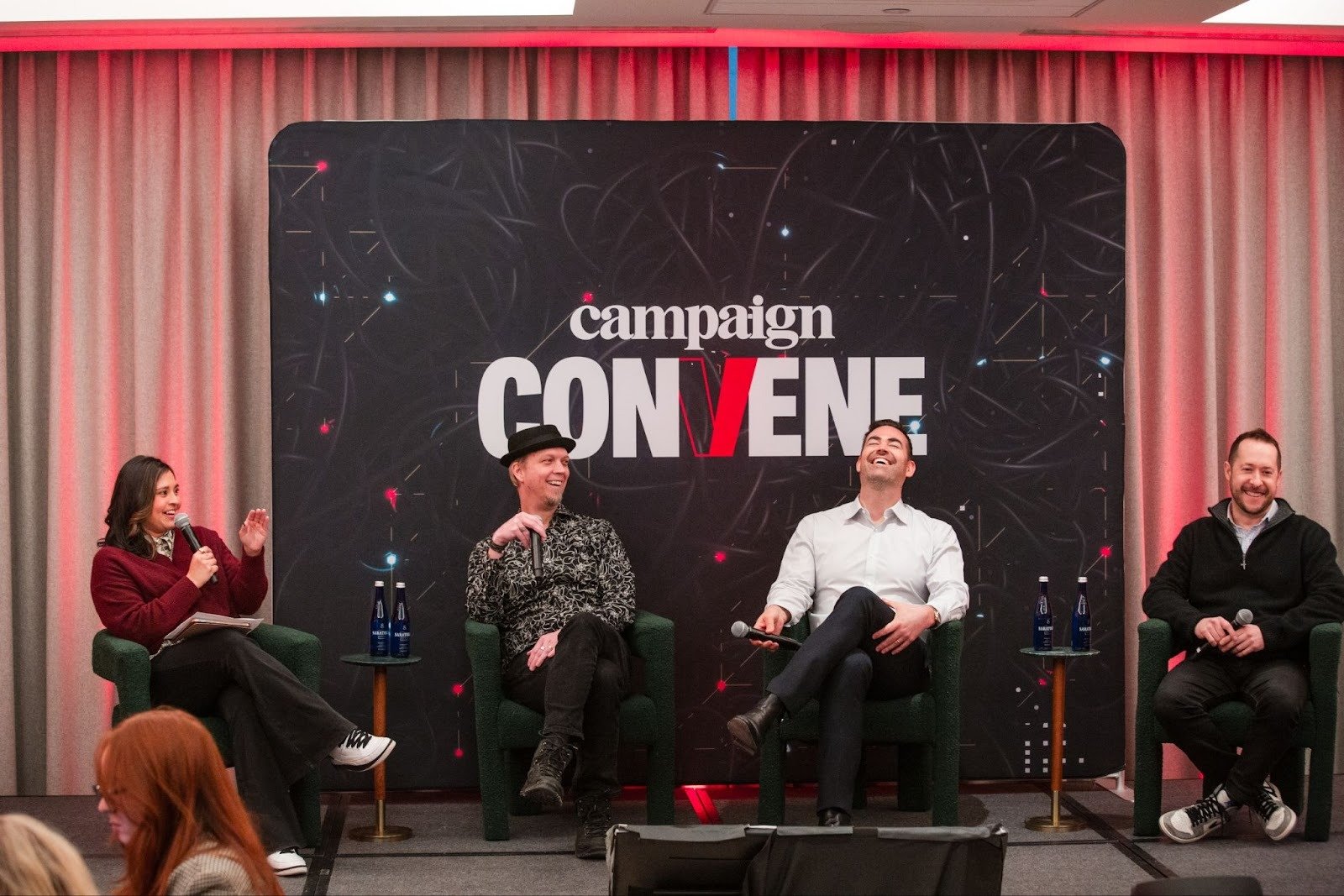 From Left: Campaign US' Luz Corona moderating "The Ripple Effect of AI" with Razorfish's Brian Brown, Newell Brands' James Clarke, and Swayable's James Slezak.
The event’s “Ripple Effect of AI” conversation brought together James Slezak, Founder and CEO at Swayable; James Clarke, Head of Media at Newell Brands; and Brian Brown, SVP and Creative Innovation Lead at Razorfish to explore AI’s impact on creative production, enterprise marketing operations, and creative pre-testing. A common theme emerged: AI is dramatically accelerating how marketers test ideas, generate insights, and improve campaign outcomes.
Watch the full Campaign Convene session below and keep scrolling for three takeaways for marketing and insights teams using AI to support creativity and measurement.
AI is removing bottlenecks in insights analysis
For many marketing and insights teams, the biggest barrier to faster decision-making is the time it takes to process and analyze consumer data. AI is reducing the manual time it takes to identify the most relevant creative testing insights—from weeks to a matter of minutes—allowing teams to focus on higher-value work such as creative ideation and presenting their findings to stakeholders.
As James Slezak put it, AI enables data scientists to speed up low-level analysis so they can operate at a higher level.
“When you look at what geniuses and people with PhDs have to do, they're sitting around pulling a bunch of data which is often rote,” said Slezak. “It's been incredible just to have that automated reliably by these agentic systems at 10X the rate at which they can give you an answer to a hard problem.”
For marketing organizations at companies such as Newell Brands and Razorfish—both of which have used Swayable to pre-test their creative—relevant consumer insights that once took weeks to access can now be generated in near real time, enabling faster iteration and smarter decisions.
Faster creative testing turns marketing into a continuous learning loop
AI isn’t just accelerating analysis—it’s also enabling marketers to test more ideas before committing large media budgets. Instead of relying on a few internally approved concepts, teams can now prototype and pre-test many variations, learning quickly which ideas actually persuade target audiences.
James Clarke at Newell Brands—the umbrella company of consumer brands including Sharpie and Paper Mate—highlighted how predictive tools and creative testing help teams make decisions backed by evidence before launching campaigns:
“A big theme for us at Newell is how we move from being reactive to predictive,” said Clarke. “If I can easily pre-test creative right before I spend a bunch of precious media dollars, that’s certainly going to allow me to have a competitive advantage against those who aren’t.”
Slezak also emphasized that the shift to using AI-powered pre-testing allows marketers to move away from subjective decision-making around their creative.
“The obvious question is what’s better and what’s worse? Pre-testing is a virtuous circle that allows you to answer these questions and improve on your ideas,” Slezak added. “We've seen tremendously large improvements in the brand lift you get from a campaign. And that’s game changing.”
AI increases creative capacity along with efficiency
The most effective AI implementations for marketers aren’t about doing more creative work with fewer people. They're about unlocking creative capacity that didn't exist before—granting the ability to test more content ideas, quickly generate insights to inform creative changes, and being able to proactively pivot campaign strategy.
When AI absorbs the time-consuming, repetitive work—from film logging to manual insights analysis—teams can put more time into higher-level strategy that results in bold, culturally relevant creative that drives ROI. Brian Brown at Razorfish, captured this sentiment well:
"Creatives didn't go to art school or film school because they want to log footage—they want to edit,” he said. “When you can get from the footage to an edit in a minute, you're using AI in a way that allows you to get to the art faster. That’s what we’re doing in all aspects of our work.”
The same principle applies across marketing and insights functions. AI is becoming more useful in handling the rote so teams can focus on the work that actually requires human judgment—and gain a competitive edge as a result.
Moving forward, the AI opportunity isn't one-size-fits-all. Different marketing functions will find different value in automation across content generation and analysis—but one of its primary benefits will be enabling marketers to rapidly identify which creative ideas move people, and which ones don't.
"AI is a bit like the internet. There’s a whole new stack of technologies emerging and each piece has its own role,” said Slezak. “The most important bits for marketers are speeding up the creation process and being able to get more insights more quickly from their data."
Learn how the Swayable Insights Factory accelerates consumer insights generation for global brands.
Book a demo today to test out these AI tools.