

Marketers love to measure engagement. The rise of digital advertising made it easier than ever to analyze how consumers interact with ads, counting clicks, likes, and views. These metrics have had a lot of appeal as leaders seek to build data-driven marketing operations—but there’s a catch. None of them provide insight into the fundamental goal of a brand campaign: swaying consumer preferences.
In fact, a 2025 survey of more than 1,000 marketers and creatives, conducted by the Lions Advisory, finds that more than 50% rate their ability to develop high-quality campaign insights as poor. This suggests that more than half of marketing teams are making key decisions based on little more than what they had in a pre-digital era: focus groups, instincts, and the preferences of the highest-paid person in the room.
“Half the money I spend on advertising is wasted,” marketing pioneer John Wanamaker is supposed to have said: “The trouble is, I don't know which half.” Research firms like Nielsen have shown that the biggest driver of this variability is the creative itself—what the ad actually shows and says—more than tactical details like its targeting and placement.
So, which ads actually change minds? Measuring what really matters—persuasion—has been possible since the 1990s, when measurement firms like Milward-Brown (now part of Kantar) introduced brand lift studies. These are randomized controlled trials (RCTs): scientific experiments that can definitively prove changes in consumer attitudes. They analyze differences in the opinions of consumers who are randomly selected to view ads versus not, determined through quantitative surveys.
In theory, this might resolve Wanamaker’s dilemma. But in practice, brand lift studies are expensive and time-consuming. They can take as long as two months to execute, requiring marketers to run campaigns with sufficient reach, and then follow up with surveys and analysis. Even in the ‘90s, when some campaigns were planned almost a year in advance, marketers could not wait that long. Today, it’s even less feasible to use these studies to decide on the right content for a campaign. The aforementioned Lions Advisory study found that nearly 60% of brands struggle to react quickly to cultural moments.
“We’ve never lived in more fast-paced and challenging times; just ask any marketer or brand manager. Only brands who understand the current culture can thrive,” says Dominik Prinz-Barley, Head of Brand at Google. Prinz-Barley was previously a partner at Interbrand, an agency famed for explicitly quantifying the dollar value of the world’s top brands. “Static businesses are seen as boring and unresponsive to people’s needs. The reality is simple: it is either ‘change the game’ or ‘game over.’”
Enter rapid RCT persuasion testing
Fortunately, recent innovations offer marketers a faster path.
Chris and Ryan Detert, two brothers who founded influencer marketing firm Influential, faced a challenge. Influential runs creator campaigns for brands like Hilton, Amazon, Pepsi and now 300 others. With social media spend expected to surpass linear TV this year, the firm’s campaigns were winning share rapidly away from traditional, agency-produced advertising. But their clients kept asking the same question: how can we be sure this new content works?
Influencer creative is based on the authenticity and unique personalities of creators, making it different from traditional agency creative, with the potential to be much more connected to current trends. Influential’s CMO clients realized this and wanted to allocate greater budget share, but their CFOs and CEOs needed hard evidence that it would increase the impact of those dollars.
“The excitement of influencer marketing in the early days was checking a box and saying you were doing something cool and innovative,” said Chris Detert, CCO of Influential. “But that only lasted so long.”
The Influential team started conducting traditional brand lift studies. They took weeks to complete, but proved that some of these campaigns were driving unusually high impact for the brands. Thankfully, technological advances since the ‘90s—particularly the rise of smartphones and cloud computing—have enabled rapid RCT pre-testing, allowing marketers to measure persuasion before campaigns launch. Pioneered by my firm, Swayable, these methods enable marketing teams at more than 100 brands to quantify persuasive impact within 24 hours instead of weeks or months. Tests involving thousands of participants provide much greater precision, while sophisticated AI and population modeling ensure the platform learns and improves continuously with each experiment.
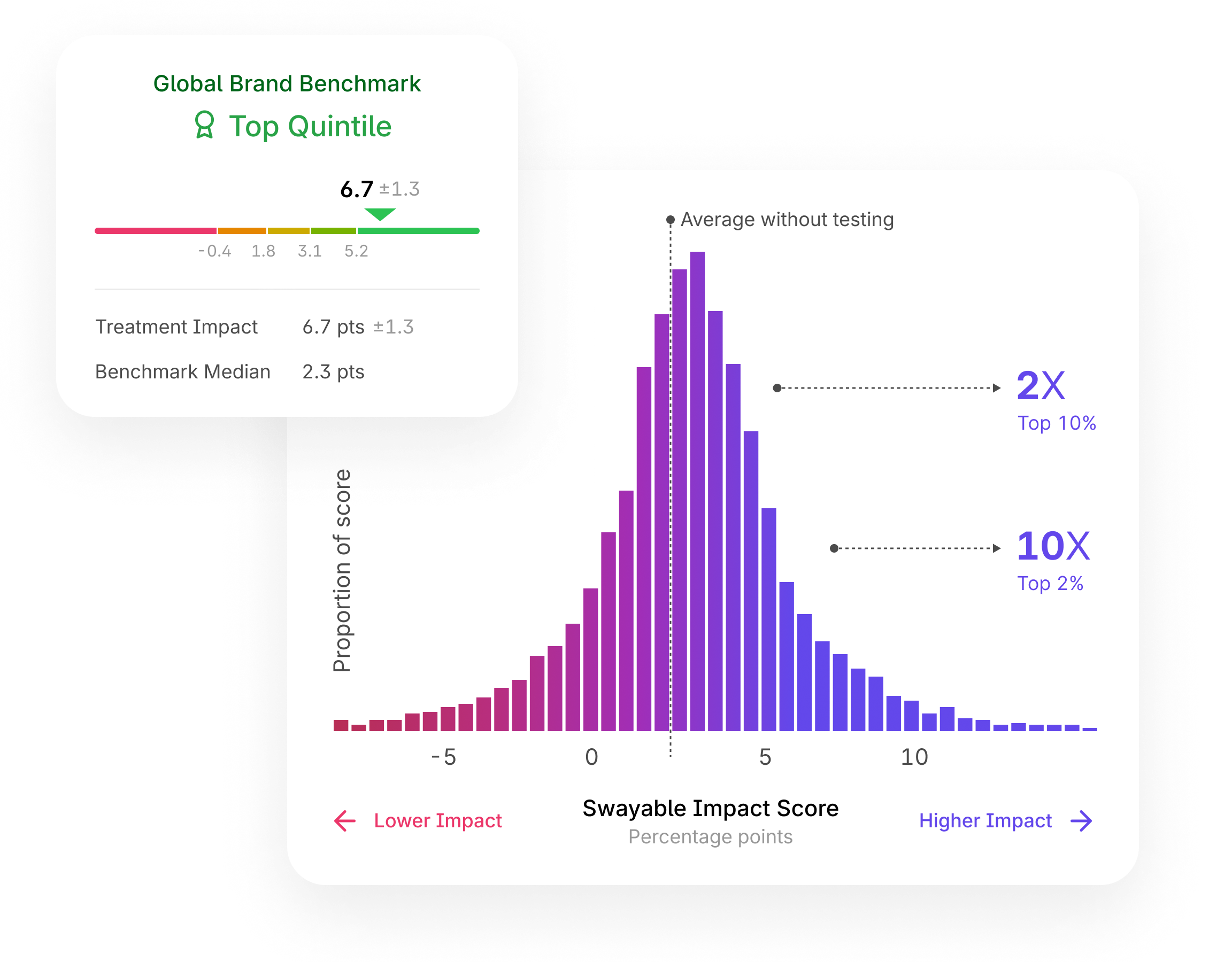
Influential was one of a set of agencies who were early to deploy rapid RCT pre-testing to measure persuasion. The Deterts learned they were able to scale their most effective partnerships rapidly, and pivot others to different ideas. They also found that their more tech-savvy brand clients, such as DoorDash and Amazon, were already using the technology, so these measurements matched already-established definitions of creative success on the client side. By separating the half that works from the half that doesn’t, increases of around 2X in brand lift became common for these campaigns.
Last year, Publicis Groupe acquired Influential for $500 million, the largest deal globally for an influencer agency. Chris attributes Influential’s growth to his team’s ability to make these real-time creative decisions informed by rapid pre-testing.
“It’s the marriage of data science with marketing that really creates the best results,” said Detert. “We are the world’s largest influencer marketing company, and I can say with confidence the reason that we are is because of this data-backed approach.”
Prototype creative lets brands unlock agile marketing
Once you measure something properly, you can improve it. But the cumulative gains are far greater if that measurement happens quickly enough that rapid cycles of iteration can be established. This is the core idea behind agile marketing. Businesses from app-based services to century-old CPG brands are starting to use rapid RCT lift measurement to build agile, adaptive marketing operations.
Bimbo Bakeries USA (BBU), the nation’s largest seller of baked goods, is one such business. Working with strategy consultants Bain & Co, company leadership decided in 2023 to ramp up their spend on brand marketing considerably. Like many CPG brands, BBU needed to kickstart growth with new generations of consumers, as older loyal cohorts aged out. For its iconic brands like Thomas’ English Muffins, Sara Lee, and Entenmann’s, there were many ideas. But which would work?
For Nicole Kane, then VP of Marketing Transformation, it was clear how to answer this. True agility meant getting learnings and improvements to campaign concepts in two-week sprint cycles. Testing couldn’t wait for final creative, since the production process to get to final end-products, whether digital, TV, or cross-channel, typically took weeks or months.
The key to rapid improvement cycles was prototype creative: quick-to-create stimulus that can be shown to consumers in pre-tests to represent a hypothesis under examination. The prototypes aren’t finished creative assets, but look like credible, albeit simple, ads. In one instance, the Thomas’ team needed to decide whether to update the tone for their campaigns to reach Gen Z consumers, potentially shifting to an edgier brand voice. Mike Jensen, Senior Brand Manager at Thomas’, developed simple, plain social media ads that featured the product in a straightforward way, but with different versions for each tone of message.
By varying that one element in the prototypes, the team learned quickly that the traditional tone generated more lift than any proposed “edgy” alternative. They “failed fast” on the new tone idea and moved on quickly to explore others that worked better. This accelerated process helped BBU make smarter bets, adapt successfully to consumer sentiment in real time, and link marketing spend directly to business outcomes. Failure wasn’t seen as a setback—it was embraced as part of the learning process. Only 10% of BBU’s tested hypotheses ended up being scaled, but that selectivity built confidence in the investments that did move forward.
“When a hypothesis fails, we don’t get discouraged,” Kane explained. “We fail fast, and it solidifies confidence that those hypotheses that have been proven successful are really valid.”
Use data to empower creativity, not constrain it
Successfully deploying these agile marketing approaches requires a shift in how creative teams use data.
Insights managers sometimes describe a divide between data and creative, while the creative professionals can perceive data-driven approaches as limiting their imaginative freedom. These are concerns that marketing leaders must surface and address directly to create agile marketing programs. Accomplishing this effectively requires explicit recognition that creative teams have a uniquely central role—and that the rest of us, including leadership, are there to make them successful.
This can be a mindset shift for organizations where teams have focused on checklists of practices, A/B engagement testing, and reports that arrive weeks after campaigns are launched. All of this obscures the fact that this work is fundamentally about getting the most effective stories from storytellers to audiences. The buy-in and direct participation of creatives in agile marketing, including test results analysis, is crucial. These programs build a deeper, more accurate understanding in the minds of storytellers on how to persuade.
One of the most exciting experiences is witnessing a change in the way creatives and strategists see data once rapid RCT results become available. Getting these results the next day opens up the possibility of taking greater creative risks.
“It allows our creators to tell more authentic stories because we can validate ideas early instead of guessing later,” said Maura McGill, Head of Paid Media at DoorDash. “Good data doesn’t limit creative freedom, it fuels it. It gives creators the confidence to try new things, knowing they have the evidence to back it up if it works.”
What it takes to measure persuasion successfully
Measuring persuasion isn’t just a technical upgrade. It’s a mindset shift. Marketers getting the biggest wins from agile creative testing have made three big moves:
- They measure what matters. They don’t merely count clicks or track eyeballs in more detailed ways—they demand proof that their stories are actually changing hearts and minds.
- They make marketing iterative, not linear. Create, test, learn, refine, repeat—using prototypes, not just finished products. Agile marketing takes a page from product innovation, building consumer impact in rapid, adaptive cycles rather than slow, rigid processes.
- They empower their creators. Rapid testing helps creatives take bigger risks, zero in on core storytelling choices, and move quickly without losing confidence. Data moves from being a constraint to a catalyst for bold, innovative work.
Of course, getting there isn’t easy. Old habits—especially a bias toward post-launch, in-channel measurement—can slow teams down. Leadership has to clear the path, frame testing as creative empowerment (not a threat), and celebrate learning, not just winning.
Marketing is changing. In an environment where consumer sentiment, technology, and even the economy can shift overnight, the brands that thrive won’t be the ones that already know the most. They’ll be the ones that learn the fastest.
In the new era of agile marketing, speed, evidence, and creativity aren’t trade-offs. They’re the foundations of competitive advantage.
Looking to move beyond engagement and measure persuasion? Book a demo with Swayable today.
James Slezak is CEO of Swayable, the measurement technology company. He is also a guest instructor at MIT’s Sloan School of Management and a council member of the World Economic Forum Global Future Council on Information Integrity. He previously served on the senior management team at The New York Times and as a consultant at McKinsey.