
The 2024 election cycle exposed a persistent problem in campaign analytics: confusing optimization tactics with strategy.
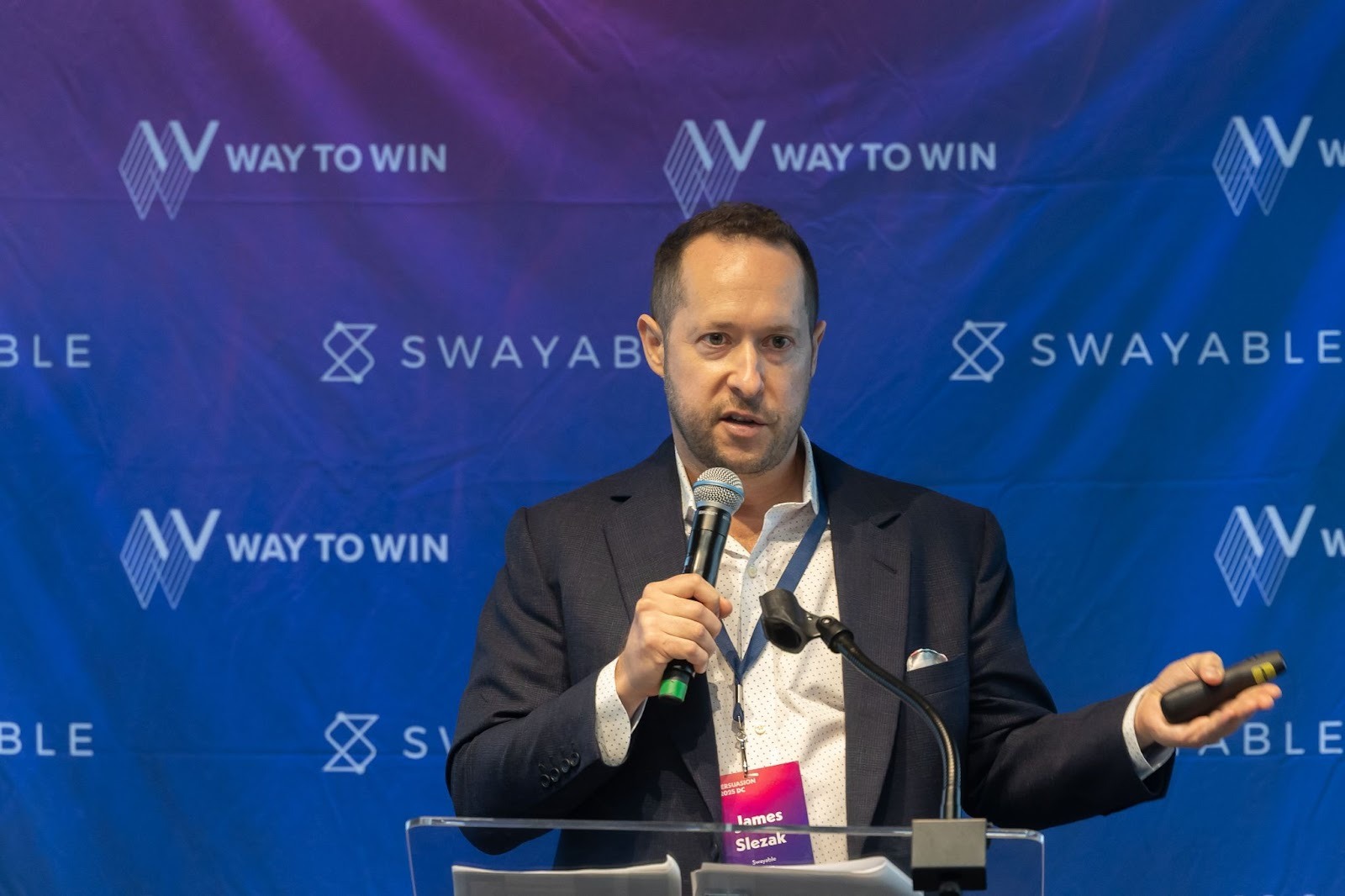 Swayable CEO James Slezak shared best practices for data-driven campaign messaging at the Persuasion DC summit.
Polling, message testing, and analytics played a central role throughout the cycle—shaping spending decisions, creative strategy, issue emphasis, and targeting. But in some cases, campaign leaders used these tools to ask questions they couldn’t responsibly answer: what a campaign should stand for, who it should stand up for, which issues matter, and which don’t.
Public opinion measurement can be done in increasingly powerful ways, but it is not a substitute for leadership, strategy, or values. It cannot tell a campaign what to believe or who to fight for. What measurement can do—if executed properly—is enable campaigns to understand when persuasion is effective, how to sharpen messages through iteration, the key elements of effective content, and why strong messages succeed across issues and audiences.
Over the past year, leaders of mission-aligned campaigns across the U.S. and around the world tested thousands of messages and ads on the Swayable platform, identifying precisely what impact they had on public opinion. At the Persuasion DC conference, co-hosted alongside Way to Win, Swayable CEO and Founder James Slezak shared these six insights about what we’ve learned from past election cycles with a group of elected officials, campaign leaders, and advocacy partners.
1. Persuasion is possible on most issues
The age old questions for electoral campaigns: should we talk about this, or should we talk about that? Should we always be trying to pivot back to safer ground where we know voters already agree with us?
Swayable deployed tests for the overwhelming majority of battleground district congressional campaigns and many other advocacy groups in 2025. We calculated the average performance of each issue (in magenta below) that featured in an ad.
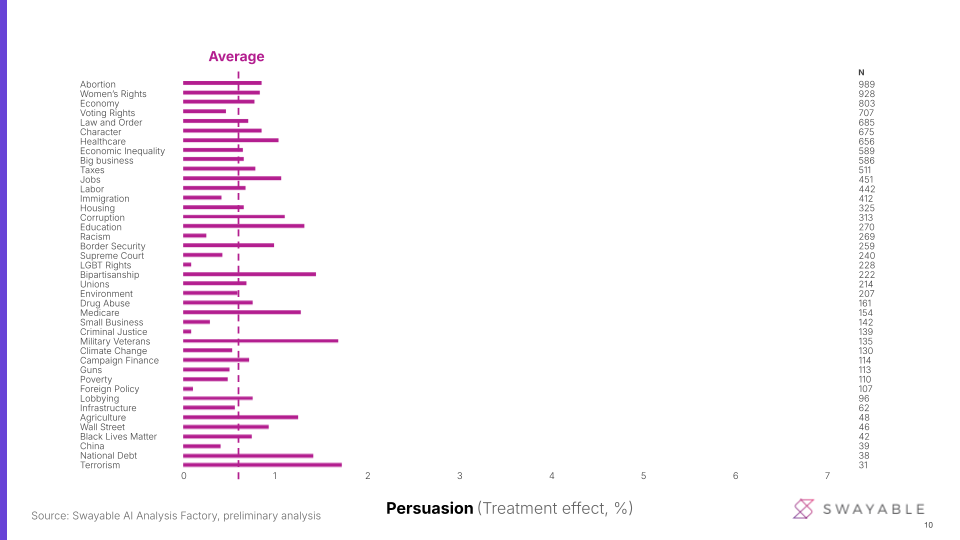
Our view is that this kind of analysis isn’t particularly useful. It mostly represents the quality of messages campaigns tended to test at a particular time on each issue.
But when you look at the top 10% of ads (in purple below), you can see that the most effective messages can persuade, no matter what topic a campaign is spotlighting.
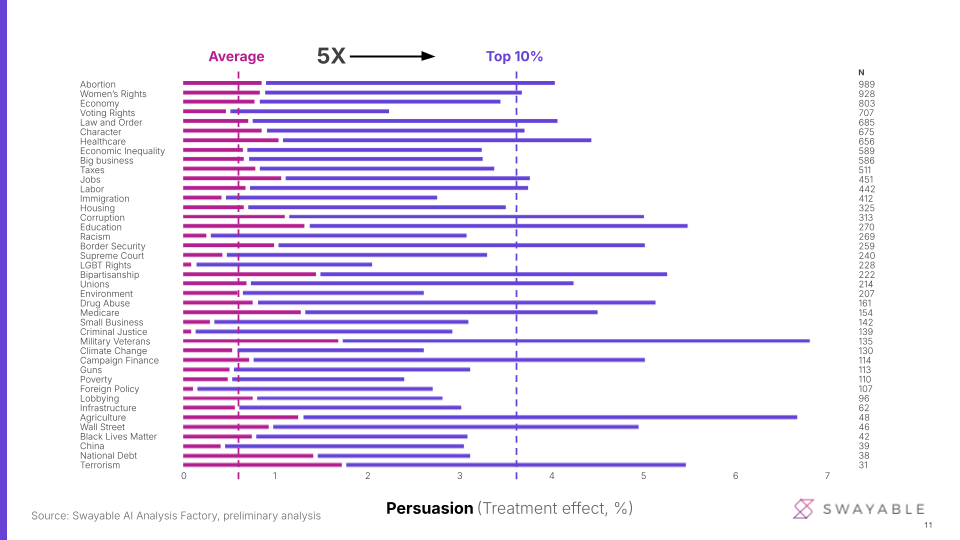
For better or worse, in this media environment, candidates don’t get to decide what gets talked about and what doesn’t. Proactive message testing can help campaigns and organizations be prepared to talk about everything in a way that persuades and minimizes backlash.
2. Don’t shy away from issues that initially yield disappointing results
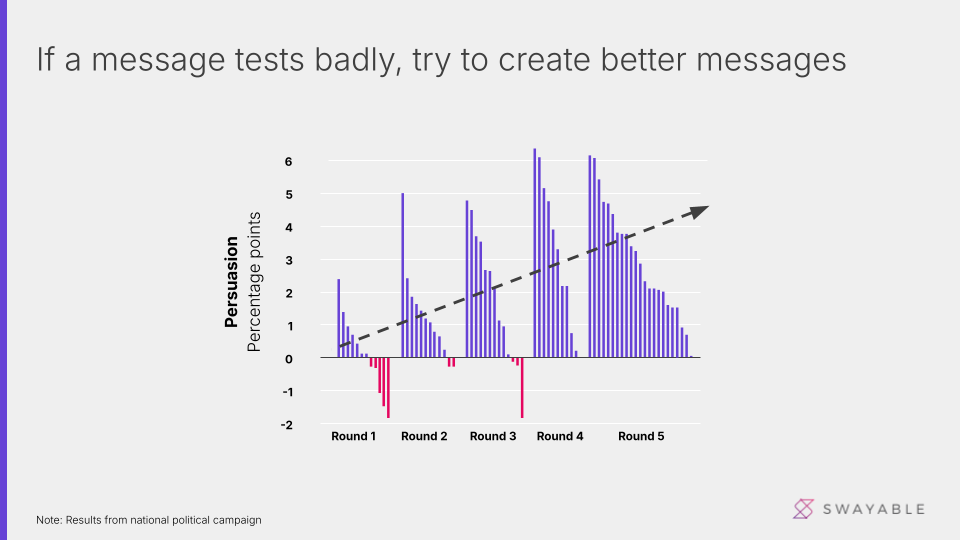
When a campaign message tests poorly, it doesn’t mean the entire issue is a “distraction,” or that talking about it is a bad idea. It may be a sign that you haven’t found your best message yet.
We find that with all types of clients, from major brands to political campaigns, iterative testing—starting early with concepts, developing messages, and then testing actual creative —leads to the highest measured levels of persuasion. That’s often how clients get their ads to be in that top 10%: testing, refining, and testing again.
It turns out that great content can persuade, even when it’s about the toughest issues. It pays off to find the most persuasive message, whether you are on offense, maximizing gains, or on defense, inoculating against losses.
Testing can’t tell you what to believe in or what to stand for. That’s not the kind of question you should even ask data people. What Swayable provides is a solution for message optimization.
You should already know what’s important to you and the movement you’re leading.
Soft drink CMOs already know what their brands are about when they test ad concepts. Are they about being healthy or about being fun? Are they trying to provide comfort and stability or shake things up?
We think campaigns for public office need to adopt this approach, too. The most successful candidates are crystal clear on their values, who they are fighting for, and why. Positions on issues, and whether or not you address them, tend to follow logically from there.
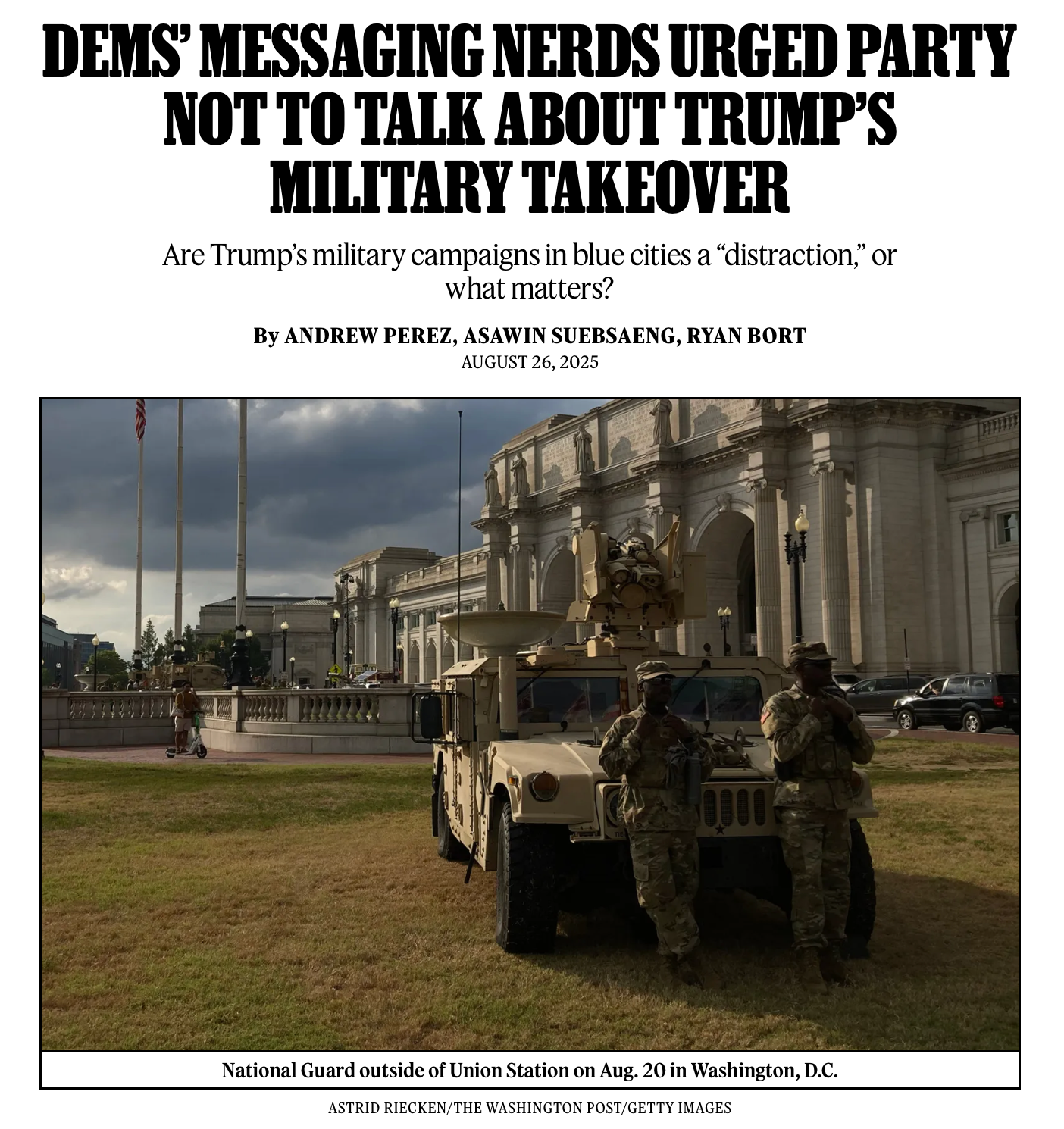
An example of leaders leaning too much on messaging nerds to decide what really matters.
Message testing is most successful when used to find the ideal way to tell your story, versus using it to figure out whether you should or shouldn’t address a certain topic. What we do best is help those exercising real political leadership to achieve maximum persuasion.
4. Pay attention to the wide part of the political ‘sales’ funnel
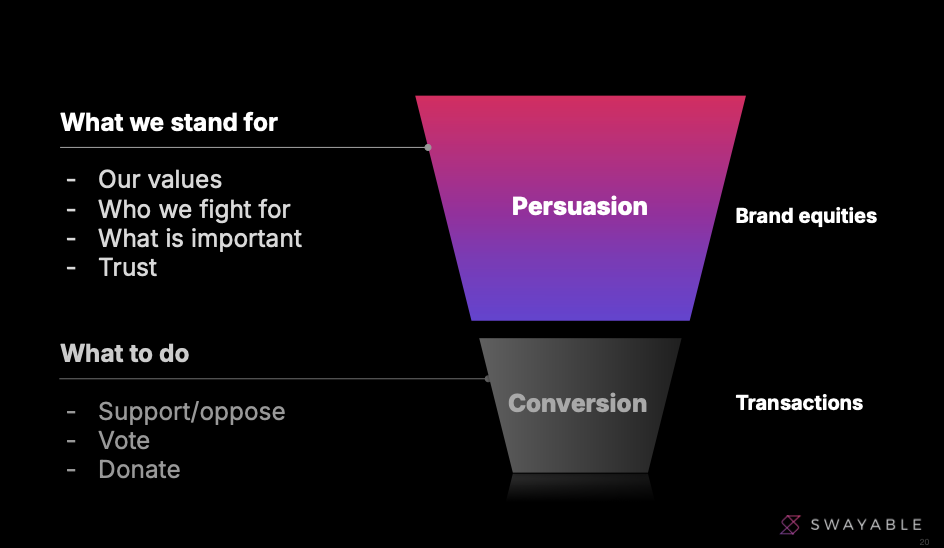
Often campaign strategists are rightfully focused on the narrow bottom of the funnel. After all, votes determine if you win or lose. But when you are just optimizing for transaction metrics—such as securing a purchase or a vote—it is extremely difficult to win consistently.
Some of the most important messaging comes way before conversion. We know from working with some of the biggest brands that the most successful ones don’t achieve long-term growth by prioritizing conversions. The size of the bottom of the funnel comes from growing the top, by building trust and relationships.
Coca-Cola doesn’t make brand decisions based on surveys of the people who are on the fence between them and Pepsi. The best brands take great care to maintain and grow trust, and stay top of mind for those who already see or are poised to see their value.
They do testing to uncover how to tell the story of their value in the way that connects best with their audiences. Then, they tell that story relentlessly. The conversion step—to purchase or to vote —flows naturally once an audience feels emotionally invested in a brand’s story.
5. Waiting until the end of the cycle to run your ads is not an evidence-based strategy
Ads are the primary use of funds for campaigns, greater than all other expenditures put together. It can be hard to predict whether an ad will outperform or generate backlash. That’s why testing is an essential part of a successful creative process.
But when is the right time to advertise? Too often, ads come very late.
There is a justified temptation to advertise close to election day to minimize decay effects (and we should advertise then too). But there are many reasons why persuading audiences early can be easier—and more valuable—than later.
Election campaigns are often run more similarly to a seasonal marketing campaign for Black Friday than to long-term relationship building with voters. Persuasion is contagious—but it takes time and disciplined repetition for a story to reverberate through an electorate. We believe it's often better to get your story straight early on so you, and all those who hear it, can repeat it for a longer period.
When clients engage with Swayable early on, they’re able to iteratively test message elements, ad concepts, and finalized creative. In turn, they become confident they have a maximally persuasive ad that can form the foundation for their campaign’s relationship with voters.
6. Don’t chase a mythical ‘median voter’ that doesn’t exist
The ‘median voter’ is a wild goose. Chasing them by only discussing issues that a mythical average voter favors (and avoiding those they don’t) demonstrates a misunderstanding of both the electorate and of persuasion.
First, median voters don’t exist. In real life, American voters, including those in the middle, are quite idiosyncratic. For many issues, they take their cues from trusted messengers, not from an unchanging set of foundational beliefs. There is no coherent segment of people with predictable middle-of-the-road opinions.
Second, the public opinion that drives these kinds of ‘popularism’ arguments (or as we prefer to call it, ‘pollingism,’ a term coined by political strategist Anat Shenker-Osorio) is not fixed. Things change. And if you seek to persuade, you have the power to make that change. We have seen positive effects on persuasion on virtually every issue.
Third, in study after study of hundreds of message tests on the Swayable platform, we find that the top performing ads and messages for liberals and progressives are the same ones that test best for moderates. The key problem isn’t what we are talking about, but how we are talking about it.
The final problem with just talking about the most broadly popular issues? In a two-party system, the smaller communities that make up a coalition are essential for winning. Leaving them out of the narrative—ignoring their concerns and priorities—is risky, and ultimately unnecessary.
Successful campaigns don’t come from rank-ordered lists of policy ideas. They inspire and persuade broad coalitions by communicating authentically, from the heart, with the people they want to represent.
Want to go deeper?
Swayable’s extensive experience working with global brands and our rapid randomized controlled trial (RCT) methodology uniquely prepares us to empower organizations seeking to rebuild and win in 2026.
If you’re interested in applying these insights to your own work, book a demo to learn how our testing approach helps campaigns change hearts and minds. You can also read more about how Swayable enables winning advocacy and electoral campaigns on our advocacy blog.
Will Packer is the principal strategist at Great Big Beautiful, which helps political and advocacy organizations develop stories and strategies that resonate emotionally, rebuild trust, and change minds. You can find more of his writing on Substack at Carousel of Progress.